

Introduction
I’ve lived in Portugal for almost five years now. In that time I’ve made plenty of mistakes, and learned a lot the hard way.
Portugal is a stunning country – breathtaking terraced vineyards rolling down to the Douro river, some of the best beaches in Europe, and cities that somehow manage to feel both buzzing and unhurried at the same time. I couldn’t even consider moving back to the UK. But the version of Portugal you experience on a two-week holiday and the version you live in day-to-day are two very different things.
So this isn’t a glossy “11 reasons Portugal is paradise” list. These are the eleven things I genuinely wish someone had sat me down and told me before I left the UK. Some are practical, some are cultural, and a few I’m still getting used to.
1. You will get ghosted by professionals… A LOT
This one caught me completely off guard. You find an accountant, a builder, an electrician, a plumber. You have a perfectly good consultation, they seem keen, you ask for a quote, and then… nothing. Silence. You follow up. Still nothing.
I cannot tell you how many times this happened to me in the early days. People simply don’t reply. Or they reply once, give you a quote, and then vanish into thin air the moment you say “great, when can you start?” It’s not personal, and it’s not rare – almost every expat I know has a story like this. But when you’re new and trying to get your life set up, it’s incredibly frustrating.
There’s a cultural side to this too, which I’ll get into more in point 7, and a practical way to protect yourself from it, which I cover in point 11.
2. Winters can be surprisingly harsh – just not in the way you’d think
Don’t get me wrong: winter in Portugal is FAR better than winter in England. Portugal gets around 300 days of sunshine a year. Manchester, in comparison, seems to get 300 days of rain – or at least that’s what it feels like. In Portugal, I’ve sunbathed in December, January, and February in a glorious 20-degree afternoon.
But.
I’ve also been here when it’s rained for weeks on end. And the thing nobody warns you about is the cold that doesn’t show up on the thermometer. The app might say 16 degrees, but by the coast, when the sea breeze picks up, it feels like it’s hovering just above zero.
And here’s the really strange part – it often feels colder inside than outside during a Portuguese winter. A lot of the housing stock here is older apartments and houses with poor insulation, single glazing, and no central heating. That’s also why damp and mould are relatively common. However, winter only lasts for 3 months…
My number one tip: get a dehumidifier. I didn’t have one my first winter, as it hadn’t even crossed my mind. Now, I wouldn’t get through a winter here without it. It pulls litres of water out of the air each day, minimises the damp, and makes the whole place feel warmer. Buy one before you need it.
3. The bureaucracy is much worse than I thought
I’d read plenty about Portuguese bureaucracy before I moved. Everyone mentions it. Reliance on older systems, lots of paperwork, things being slow. So I thought I knew what I was walking into.
I didn’t. It was far worse than I’d anticipated.
The thing the Facebook groups, Reddit forums, and guidebooks don’t capture is the sheer number of catch-22 situations. To get X, you need Y. But to get Y, you first need X. You go round in circles, getting bounced between offices, websites that don’t work, and queues that lead nowhere. It is genuinely overwhelming, and I say that as someone with a legal background and who has lived in several different countries.
I tried to get help from professionals and largely failed. Either they didn’t reply or they were flat-out wrong, telling me things I already knew to be incorrect or completely irrelevant to my situation.
Some delays you simply can’t avoid. The time it takes to get your residency card from AIMA is supposed to be up to 90 days, but I’ve known it to take considerably longer. Exchanging your driving licence can drag on too. These are just realities of the system.
But with the right help, the bureaucracy stops being a nightmare and becomes a mere inconvenience. It’s still relatively slow, but there’s a world of difference between fumbling around in the dark on your own and having one person who actually knows the system guiding you through every step.
That’s exactly how we operate at Relocation Simplified – one dedicated, English-speaking point of contact who walks you through every obstacle. No call centres, no being passed around. We’ve also spent years building a network of genuinely reliable professionals across Portugal – tried, tested, and trusted. Whether you need a Portuguese lawyer, an accountant, a buyer’s agent, a building inspector, a mortgage broker, or an architect, we’ve got someone we can vouch for. And honestly, that network is worth its weight in gold here, for reasons that’ll become clear by the end of this list.
4. The slow pace of life applies to everything – learn to love it or lose your mind
People love to talk about Portugal’s relaxed pace of life as a selling point. And it is – it’s one of the best things about being here. But what they don’t tell you is that “slow pace of life” applies to everything.
The builder who’ll come “next week.” The bank that takes three visits to do one thing. The café that’s in no rush to bring you the bill because, why would you want to leave?
When you first arrive, fresh from the relentless tempo of the UK, this can drive you up the wall. You’ll feel like nothing is happening and everything is taking ten times longer than it should. And sometimes it is.
But here’s what I’ve come to understand: the slowness isn’t a bug, it’s the whole philosophy. The same culture that makes the bureaucracy frustrating is the one that means nobody bats an eyelid when you sit over a coffee for two hours, that values a long lunch with friends over rushing back to a desk, that puts living ahead of doing. You can’t have one without the other.
So my honest advice is this: learn to be patient. Properly patient. The pace will change you if you let it – and it changes you for the better. The people who struggle most here are the ones who fight it. The ones who thrive are the ones who slow down to match it.
5. Cars are crazy expensive
When you first move here, you’ll likely have a mental budget for what a car should cost, based on what you’re used to back home. If you’re coming from the UK or the US, you’re accustomed to cars losing up to a third of their value in the first year. In Portugal, forget everything you think you know. Depreciation here isn’t a cliff, but more like a very gentle slope. A car that’s 10-years old can still command 70% of its original price. Brilliant if you’re the one selling; painful if you’re the one buying.
The reason is the tax structure. There’s a one-off registration tax called the ISV, calculated on engine size and CO₂ emissions, and then 23% VAT (IVA) on top. Crucially, the VAT is applied to the price including the ISV, so you’re effectively taxed on the tax. The combined effect can push the price of a new car 30 – 50% higher than the same model in Spain or Germany.
Because of this, the Portuguese tend to hold onto their cars for a long time, and the second-hand market stays stubbornly expensive. Good used cars get snapped up fast, and you won’t find the kind of bargains you might be used to on Autotrader back in the UK.
There is one important exception though. If you owned your car for at least six months before moving to Portugal, you may be eligible for a tax exemption if you choose to import your car. Many of our clients make full use of this, but it can only be done once, and within a specific timeframe. It can genuinely save you thousands. If this is something you’re considering, get proper advice on whether you qualify before you do anything else.
6. Portuguese people are among the friendliest in Europe
I want to be careful here, because friendliness is subjective and a lot of it depends on the energy you put out. But in my experience, the Portuguese are genuinely warm, generous people… once you make a bit of effort.
And the effort that matters most is being polite and speaking a bit of the language. Nobody expects you to be fluent. But learning even a handful of basic phrases changes everything. A simple bom dia (good morning), obrigado/obrigada (thank you), com licença (excuse me), and “desculpe, só falo um bocadinho de português – fala inglês?” (sorry, I only speak a little Portuguese – do you speak English?) will completely transform how people treat you.
Here’s something else worth knowing: it’s almost impossible to judge this on a holiday. Where you holidayed in Portugal is probably nothing like where you’ll actually live. In my neighbourhood there are virtually no expats. At the very beginning that felt a little daunting. But what helped more than anything was simply saying good morning to my neighbours every day, and a cheerful “tudo bem?” (all good?) to the locals.
And the single biggest thing that helped us integrate? Getting a dog. A dog is the ultimate conversation starter. Suddenly you’re stopping to chat with the same people every morning, the neighbours know your dog’s name before they know yours, and you’re woven into the rhythm of the street in a way that would’ve taken years otherwise.
7. Relationships are everything – and business runs on them
Portugal is a relationship-based society, and that extends right into how business gets done. You don’t send an email to your estate agent and expect a prompt reply with a spreadsheet of options. You meet them for a coffee. You have a chat. You build a bit of rapport first.
One of the most common complaints I hear from expats is that their emails go unanswered (point one, above). And the reason is partly cultural: email is often seen as cold and easy to ignore. If you want someone’s attention here, you call them. Or better still, you turn up in person. Things that would feel pushy or old-fashioned in the UK are simply how things get done in Portugal.
Once I understood this, my whole experience changed. Build the relationship first, and doors open. Treat everything as a transaction to be handled by email, and you’ll spend a lot of time wondering why nobody’s getting back to you.
8. Learning Portuguese is VERY difficult
I’ve lived in a few different countries and have some experience with French, Spanish, and German. I’ve never tried to master any of them in real depth, but even so, all three felt more approachable to me than Portuguese.
On paper, Portuguese can look quite similar to Spanish, and if you read it, you can often half-guess your way through. The trouble is the pronunciation. It’s the spoken language that’s the real mountain to climb, both in making the sounds yourself and in understanding what on earth people are actually saying. Portuguese swallows and drops huge numbers of vowel sounds, so words run together and whole syllables seem to vanish. It doesn’t help that single words can carry a whole range of meanings depending on the context.
But there are some good options for learning. Don’t rely on Duolingo – it’s Brazilian Portuguese, which can be quite different to European Portuguese. Also, learning how to say “his turtle is very fast and likes cheese” doesn’t really help when the plumber asks where the leak is. Instead, I highly recommend enrolling in a Portuguese language course – whether one of the free government-provided courses, or a local private class. You’ll be with fellow expats in the same boat as you, and it’s a great way to meet people, too.
And if you’ve got kids – prepare to be humbled. Children absorb it like a sponge. I have friends whose four-year-old speaks better Portuguese than they do, almost entirely thanks to their Portuguese nanny and a few months of nursery. It’s equal parts adorable and infuriating.
9. Revolut and Wise are great – until they’re not
For a long time after I arrived, I relied on the likes of Revolut, Wise, and Monzo – even though I had a Portuguese bank account. Honestly, for the early days, they’re brilliant. A combination of them lets you take advantage of each one’s free withdrawal and exchange allowances and dodge the worst of the foreign-transaction fees.
Those apps are great for getting started and for smaller, everyday spending. But once you’re actually living here – paying rent, moving larger sums across, transferring money regularly into a Portuguese account – they stop being the most cost-effective option. The fees and exchange margins on bigger or recurring transfers add up far more than you’d think, and you can quietly lose a meaningful amount over a year without ever noticing it leave.
The key tip: for moving larger or consistent amounts into your Portuguese bank account, there are far better – specialist currency exchange companies with much better rates and lower costs on substantial transfers. We work with someone who specialises in exactly this, and the savings over time can be significant. If you’re going to be moving money internationally on any kind of regular basis, it’s well worth getting this set up properly from the start rather than learning the expensive way like I did.
10. There’s so much more to Portugal than the beaches
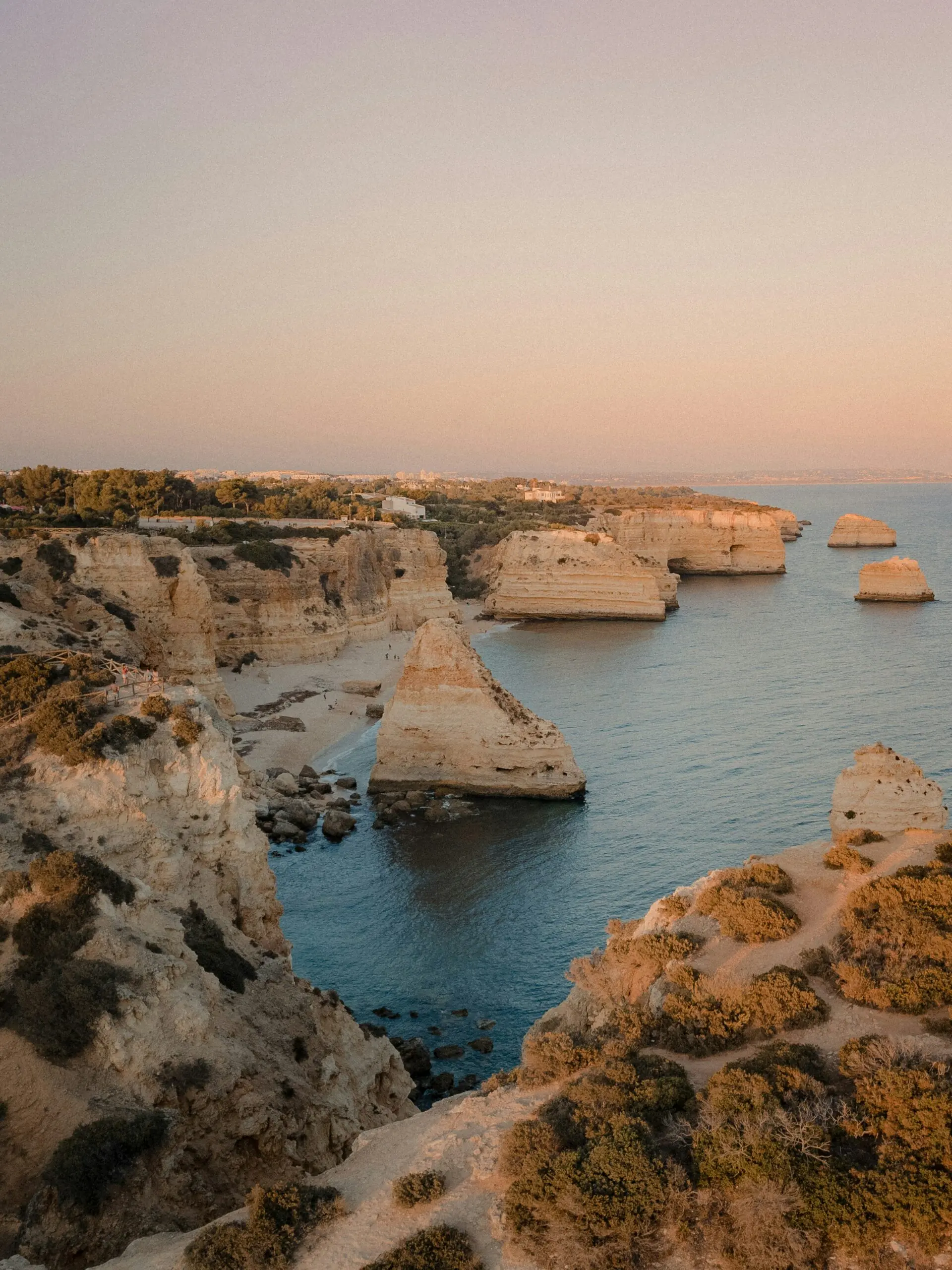
Yes, Portugal has ridiculously beautiful beaches. Everyone knows this. Praia da Falésia, with its dramatic rust-coloured cliffs, has been crowned the best beach in the world more than once. The hidden coves of the Arrábida Natural Park, just south of Lisbon, have water so clear and turquoise you’d swear you were in the Caribbean. The beaches alone would be reason enough to visit.
But limiting Portugal to its coastline is like judging a book by its cover.
Head inland and up north to the Douro Valley, where ancient, terraced vineyards tumble down the hillsides to the river – one of the most breathtaking landscapes in Europe. Go to Nazaré, where surfers ride some of the biggest waves ever recorded on the planet. Wander the medieval streets of towns like Óbidos, with its walled castle, or Évora, with its Roman temple, where you genuinely feel like you’ve stepped back several centuries. Visit the fairy-tale palaces and castles of Sintra, tucked into a forested hillside.
And here’s one that surprises everyone: Portugal has a ski resort. Up in the Serra da Estrela, the highest mountain range in mainland Portugal, you can actually ski in winter. The same country where you’re sunbathing on the beach in February has snow on its peaks. After five years here, I’m still finding places that genuinely take my breath away. Don’t box yourself into the Algarve.
11. The “expat tax” is real
This is the one that costs people the most money, and almost nobody really talks about it before you move.
There’s a real price to being foreign here – at least at first. When you don’t know the local market, don’t speak the language, and don’t have a trusted network, you end up paying more for almost everything… A LOT MORE.
Lawyers and accountants are some of the biggest culprits, often charging ridiculously inflated fees because they know newcomers don’t yet know what’s reasonable – and they take full advantage of that. Tradespeople also typically quote higher for an obviously foreign client. You overpay for a property because you had no idea what comparable places down the road were actually selling for. You sign a rental contract with terms a local would never accept, because you didn’t know any better.
It happened to me, and it happens to almost everyone who arrives without someone genuinely guiding them. And it ties right back to point one – the difficulty of finding reliable professionals in the first place. When you can’t even get people to reply to you, you end up taking the first quote you can get, from whoever bothers to show up, often at a premium.
This, more than anything, is why having someone genuinely in your corner makes such a difference. Not just for the visa paperwork, but for the day-to-day reality of building a life here without bleeding money at every turn. Our vetted network of professionals exists precisely because I, and thousands of other expats, got burned learning these lessons ourselves – so our clients don’t have to. Knowing what a fair price looks like, and having trusted people who’ll actually pick up the phone, is worth far more than most people realise until they’ve gone without it.
Final thoughts
None of this is meant to put you off. After almost five years, I wouldn’t change my decision for anything. Portugal has given me a quality of life I never had in the UK, and I genuinely love it here. But I’d be lying if I pretended it was all sunshine and pastéis de nata from day one.
The truth is that most of the difficulties on this list – the bureaucracy, the ghosting, the expat tax, finding people you can trust – come down to the same root cause: not knowing the system, and not having anyone reliable to guide you through it. That’s the entire reason Relocation Simplified exists. We’ve made the mistakes so you don’t have to, and we hand you the network, the knowledge, and the single point of contact that I wish I’d had when I first stepped off that plane.
If you’re thinking about making the move and want to talk it through, get in touch for a free consultation. I’d love to help you skip the parts of this list that you can skip – and enjoy the parts you can’t.